Sunday, February 15, 2009

Thali! Thali! Thali!

Ladies and gentlemen, welcome to the Hotel RRR (..rrrrrrr...). From the outside, you might feel a little suspicious. After all, it does not have a very promising look, or name...


And yet, Mysore's Hotel RRR serves The Best Thali Ever. David and I came here for lunch on our first day in Mysore. We stepped in around 3pm, which we quickly learned to be peak hour in the restaurant. Soon after entering the restaurant, we were shaken out of our "put-my-name-on-a-list" mode (which makes waiting to eat in a restaurant in New York a very civilized process) and realized we had entered a no-rules zone (not so unusual.) If you try to have lunch at Hotel RRR around peak hour, the only way to sit down is to stand guard next to a couple of tables where it looks like people might be finishing up their meal and hope that the people waiting next to you won't be quicker than you at sitting down. A kind of thali-jungle.

Luckly, we were able to return to Hotel RRR around midday a couple of days later. The restaurant was empty, giving us the opportunity to do a full documentation of the thali meal. You sit at a table with folded banana leaves waiting for use. In the middle of the table are salt, chutneys and chillies to accompany the meal.


Once seated, open your banana leaf and wipe it clean with a little water. David and I weren't too excited about getting tap water on our leaves, but it worked out...Your leaf now looks like this:


Next, create a little assortment of chutneys and chillies on the side, just so:

(We do hope you are appreciating our detailed composition.)

Next come the dahl (lentil based), the pappad (crispy extra-thin bread on the side), as well as other delicious side dishes: a coconut based cold soup, some potato based soup, tomato soup of sorts and (my favorite) curd. In addition to the dahl, this particular thali served a dish with beans and bananas in it (the little grey-green hill in the center).


And finally, the hot, fluffy rice.


Any of these ingredients can be refilled as many times as you want. There are young men walking around the restaurant with large containers of rice, dahl, and other dishes. They are also able to refill your soups, etc. Really delicious.

The only thing left to do (and the most enjoyble) is to start eating, while using only your right hand. David kndly demonstrates below:

(Yummy.)

And if you are in the mood for a little sweet after lunch, head over to Indra Cafe' (I am starting to sound like a guidebook due to the extreme exposure to our Lonely Planet.) Anyway, the sweets below are mostly made with condensed milk, sugar, and ghee. I could have eaten the whole store!


That's all for our Mysore Thali Special.
Ciao! B

Mysore and Somnathpur, Karnataka.

So, although it's been a while now, here is a little update on our travels since Hampi. On Feb. 7th we left the land of boulders, Hampi, with (drum roll) an Overnight, 2nd Class, Non-AC Train to Bangalore. Another really interesting travel experience after our overnight bus from Goa to Hampi! 2nd Class Non-AC is what many Indians travel by for long distance trips. Ours was an 11 hour ride in one of the filthiest and loudest trains I've been on so far. At the same time, thanks to our lovely sheets, we were able to create a semblance of coziness. Unfortunately David's bunker was right by a window, which caused him to catch a minor cold. We got in noisy and trafficky Bangalore very early in the morning, and caught an over-crowded, rush-hour train to Mysore at 7.30am. Because we had reservations, we were able to get our seats (having to ask 3 people to get up). The train was PACKED! Again, more than any other train we've been on so far.

The trip to Mysore was made particularly interesting by 2 factors:
1) we were sorrounded by a cheerful group of 8 men in their late 20's who were on their way back from a pilgrimage to a site in the state of Andra Pradesh. David and I really enjoyed watching them relate: sitting on top of each other, playing around, rubbing the freshly shaven head of one of the larger fellows in the group. Their body language was so relaxed and familiar with each other: a lot of physical contact and playfulness. We have noticed this kind of intimacy before, strictly between members of the same gender, and have been wondering about how homosexuality or homoerotic behavior is understood in India. We know homosexuality is looked down upon very strictly... we wonder about how people here are defined as "gay/lesbian" by their communities...

2) At one of the stops on the way to Mysore, David and I noticed a very sad woman. She was young, maybe in her early 20's, and she was squatting by the railroad looking as though she might be crying. Eventually she got up from her squatting position to engage with a young man sitting nearby: it looked like she was trying to take a plastic bag with some objects in it from him. It became apparent that they were fighting- there was a lot of tension between them. Suddenly, the man hit her really hard in the face and then shoved her to the ground. He walked away for a minute as she lay on the ground, only to come back with a heavy rock held over his head. From a small distance, he threw the rock at her- it was clearly too heavy a rock to make it to where the woman was lying, but it was quite a shocking site nonetheless. The whole scene evolved quite slowly, and nobody around minded much. I felt a strong wave of anger surge inside of me, and I had to consciously restrain myself from screaming at the man from the train while he was holding the rock up. It was a very difficult scene to witness, one that left us asking ourselves many questions about human instincts and the power of education/mindfulness/awareness.

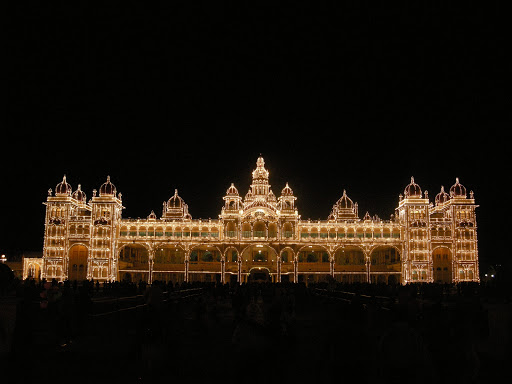
We got to Mysore around lunch time and spent the next 4 nights at the Maurya Hotel (not to be confused with the Maurya Palace Hotel :) right by the "great Maharaja's palace", one of the main attractions of Mysore. Although we eventually went to visit the palace (a gaudy and kitsch early 20th century building, the result of an unfortunate mix of British and Indian architecture) we were lucky enough to see it lit at night. We think that's really the best way to go - they light the whole place from 7-9pm every Sunday. Mysore took a while to grow on us - it was hard to make the transition from the quiet and pictoresque Hampi to the loud and polluted city. We did find a lot of pleasure in the Devaraja Market, the historical in the city. There are tons of images of this market online, but here are a couple that show you our own experience of it.

(Ready-to-go bundles of groceries for the fast-shoppers.)
(These are cubes of SUGAR! They are sold in small bits together with a light, puffy, rice snack. You can see the rice in the bottom right corner. The cubes looked like honey wax from a distance and the sugar is really delicious, coming from the many sugar cane plantations all around Mysore.)

(The most sensual and exhilarating part of the market are the two or three aisles in which flowers are sold. What you see here are spirals of threaded blossoms- mostly jasmine, so you can imagine the perfume- that people buy daily in huge amounts for pujas/prayers. Also, most of the women in Mysore wore garlands of jasmine in their hair.)

(David insited on buying me a garland so I could blend in better in the crowd. It was very romantic...)

(This sweets shop was just outside of the market. I thought the seller looked like a king of sweets, sitting as he was sorrounded by all these sugary snacks.)

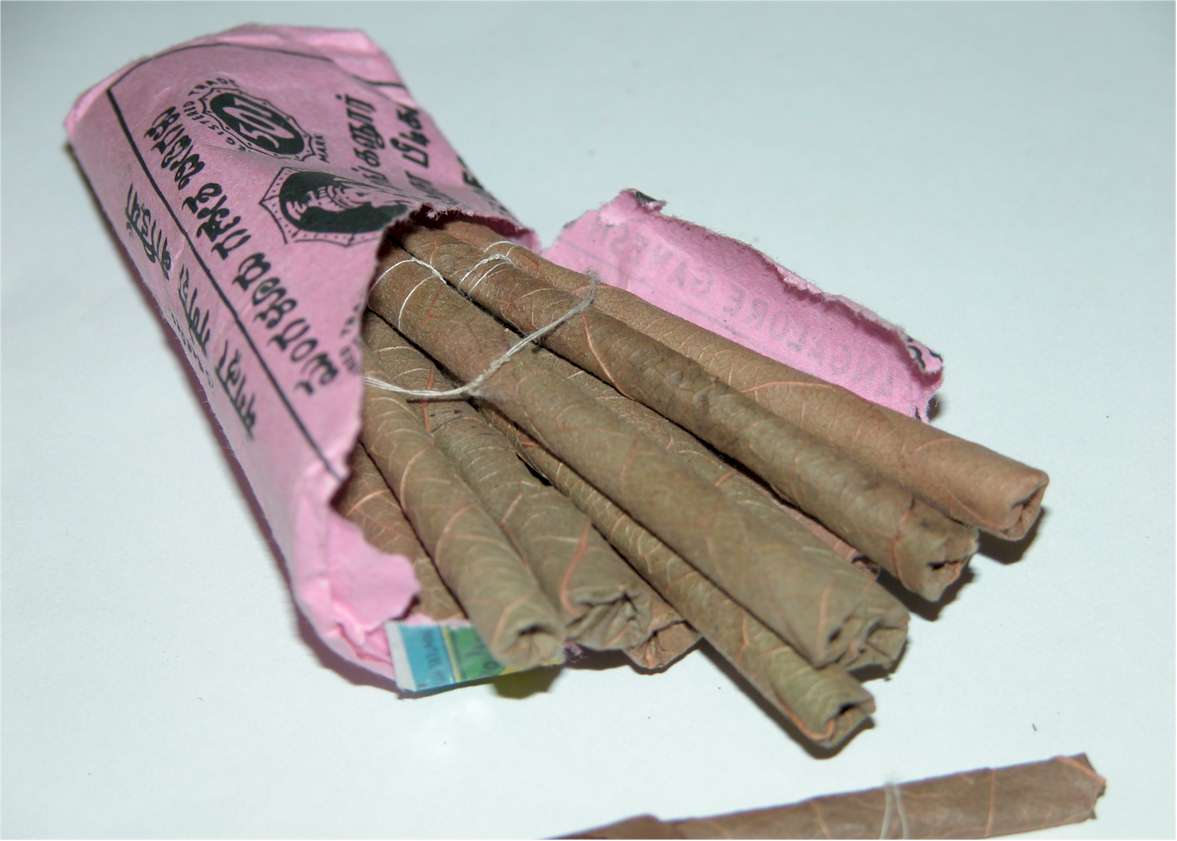
In Mysore we also went to visit a "beedi factory". This was the factory:

We went there during the afternoon siesta, and were told that usually there are more people in the same room. Also, there are probably several places where the beedis are made all around the city. In any case, there was definitely an assembly line method going on, with the man on the left rolling the tobacco in the leaves, and the man on the right cutting out the leaves into rolling paper. We are trying to remember how many they wer able to make in a day, it was something like 2,000. The man on the right also lit one beedi after the other while working: he smoked about 30 a day. We were told it's good for the health...?

Apart from the market and some delicious food (more on that on a later post), David and I were not crazy about the city. Only on our last day there did we discover that we were staying in the commercial center of town. It's probably a completely different experience to live in the more residential areas of town, where many of the Yoga Institutes have their home (Mysore has a couple of very important yoga teachers and centers.) We found some relief from the general loudness and pollution at the Royal Orchid Metropole, a hotel built by the Maharaja's family back in the colonial days. We spent a couple of evenings there, experiencing a different side of India from our backpacker's usual. The courtyard of the hotel was very beautiful and surprisingly quiet, and they had the Best Curd (yoghurt) we have had so far, as well as wonderful tandoori dishes. It was also lovely that no matter how expensive for Indian styles, our dinners never went past $20 :-)

(At night, the mango tree at the back was lit with lovely lanterns. A really romantic setting.)

Luckly we didn't run away from the Mysore area too quickly (we did think about it at first, as we were getting adjusted to the noise and pollution.) Following the advice of our train companions, as well as our semi-professional hotel manager, we made our way to a couple of sites outside of the city. The first was Chamudi Hill, on top of which is a large temple dedicated to Durga. We went to the temple very early in the morning, taking a public bus, and then made our way down the hill along the 1,000 steps that devoted pilgrims use to reach the temple. After many donations, buying of flowers, and general religious behavior, we left the temple feeling a little weighed down by the several requests for money in the temple. To think that hundreds of people go up to Chamudi Hill every day making offerings much larger than ours! There was also a large group of tourists when we got there, surely good business for the temple. The whole thing is very reminiscent of the Catholic Church, in terms of all the money that's flowing. We did find something wonderful up on the hill: a 5 meter high Nandi placed along the stone steps about 3/4 of the way to the temple, maybe a sign to encourage the pilgrims that they've almost made it.


While in Mysore, David and I also learned about the Hoysala Empire, headed by yet another powerful dynasty in the history of India. Point of interest: the founder of the Hoysala Empire was a man originally named Bittedeva, apparently a devout Jain during the time when the Jain religion was very powerful in India. At the turn of the 12th century however, Jainism started to decline, just as the Hindu worship of Shiva and Vishnu became more prominent. Interestingly, through a timely conversion to Hinduism, right around that time Bittedeva became Vishnuvardhana. By associating himself with the new powerful n in the area as well as through many military conquests, Vishnuvardhana really established the Hoysalas in the whole Kernataka region. As a result of Vishnuvardhana's mixed religious loyalties, Kernataka has an important Hindu-Jain temple (in Sravanabelagola, about which I will write more later), in which a gigantic Jain Buddha and a Jain temple have been enclosed within the walls of a larger Hindu temple.

The Hoysalas are particularly well known for their patronage of the arts (apparently because of the interest of many different queens): from architecture to music, to dance and sculpture, and more. The Hoysala architecture is known worldwide for it's incredible sculpture and design. David and I had never seen images of the famous Hoysala temples around Mysore, so we made a short day trip to Somnathpur, 2 hours outside of the city, to check it out. It was AMAZING! We eventually made it to other Hoysala temples further North, but Somnathpur was the most complete and subtly sculpted, as well as the one in the quietest location. There is only one temple there, the Keshava temple. Below are some details from the building.

(All around the outside walls of the temple, elephants are sculpted at the bottom for stability and horses above them for speed. In other temples we saw lions between the horses and the elephants, for valor. The fourth layer from the bottom is dedicated to the recounting of stories. In Somnathpur these were extracts from the Ramayana and the Mahabarata, as well as images of courtly events.)


(These were just like the elephants in Disney's "Jungle Book". Really playful and dynamic in the way they've been carved!)

(We were told that temples are meant to provide a full spectrum of the elements of life. As a result you should find anything sculpted on them, from myths and gods (such as the Vishnu above), to everyday activities, not excluding...sexy time and wrestling!! See below.)

The temples are carved out of a rock that is very soft when wet, but which hardens complitely when dry. Margot (David's mom) explained to us that in order to create such smooth carvings the artists were constantly wetting the stone while carving it. We spent about 2 hours looking at just this one temple, examining the Ramayana and Mahabarata stories carved on the walls, as well as many individual images. Below is an example of the total absorption of our observation (as well as a nice shot of my jasmine garland!)

Anyway, there is more to our traveling to tell in order to catch up to where we are now, but I have run out of time. I will update again very soon and, as always, look forward to your comments.

A presto,
Bici

Thursday, February 5, 2009

Hampi, Kernataka.

(Virupaksha Temple, at the heart of Hampi, seen from down river.)

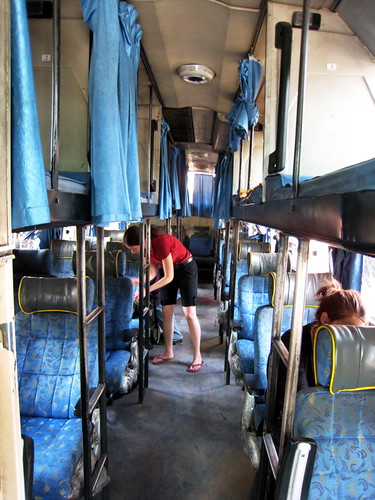
Have you ever been on a sleeper bus? I didn't even know they existed, and yet, that is how David and I got to Hampi, Kernataka, from Agonda. We left our paradisiacal beach on the evening of Feb. 1. I had not been feeling great: first a feverish day, and then the expectable - a bit of a Delhi Belly! The sickness made the whole trip that much more interesting...our bunk was way at the back of the bus, which meant that each bump got us a couple of inches off the bed :-) But apart from the particularly loud engine (which sounded like it could make the bus fly if needed), the 10 hour overnight journey was not too bad. We got to Hampi early in the morning and found a nice room at Archana's Guesthouse. We moved to a shared bathroom room (300 rupees) on our second night, but this room was our first night luxury dwelling (400 rupees)


(Notice the bed cover, a purchase from Goa that we happily use as our personal bed sheet. In general, it's a good idea to travel around with some clean sheets.)

(The street we are staying on is in the heart of Hampi Bazaar, something like the "historical center" of town. In fact, the only center of town. The village life is one of the most pleasant aspects of staying here. There are tons of little - naked - children running around, as well as people going on about their business. But the town is generally very quiet. It's very special to wake up to the sounds and rhythms of the town.)

(Hot chillies drying in the sun on one of the small streets in the Bazaar.)


Now, you can look up all the various information on Hampi on the wikipedia link, but here are a couple of points that are interesting. Between the 14th and 16th century, the area all around Hampi was known as Vijayanagara, "the City of Victory", capital of the omonimous Vijayanagara Empire. (David and I have inevitably fallen into the trap of calling it Vagina-gara, but are working on getting out of that habit...) During its peak, the V-Empire was one of the most powerful in India, alone in its ability to resist the invasions of the Delhi based Moughals. Hampi is sorrounded by the ruins of this once rich and powerful city, whose strength relied on a large military and excellent relations with different religious institutions. One of our neighbors here in Hampi has compared it to Rome, arguing that it would take 3 months to see the whole complex of ruins. I am not sure the two cities can actually be compared in magnitude, but because Hampi locals live in and on part of the ruins, sometimes it does feel a little bit like being in Rome... a little bit...

(The main street of Hampi, leading to the still active Virupaksha Temple. The road functioned, and still does, as a bazaar. People live and work on the main street.)

(A goat herder's home along the main street.)
Sometimes the main street is turned into a parade ground. A couple of days ago David and I rushed off from dinner in the direction of some loud fireworks to discover the whole city parading a large scultpure of Shiva and Parvati sitting on Nandi (their bull). Although this picture is too dark, it does some justice to the generator operated lighting system that made sure you couldn't miss the sculpture!
The parade was lead by Lakshmi, Hampi's elephant mascot. She's very cleverly trained: if you put a 1 rupee coin in her trunk and bow, she will bless you. David and I couldn't resist: she had a lovely touch. She's called the "white elephant" in town, because of the discoloration on her nose.

(Unfortunately you can't see from this image, but Lakshmi was CONSTANTLY surrounded by people and children, dancing and screaming to the beat of a walking drum circle that accompanied the parade. We could only imagine what could have happened if she had lost her temper...)

In addition to its historical importance, Hampi is remarkable for its landscape. It's surrounded by INCREDIBLE boulders of red/ochra/grey granite. They are precariously placed on top of each other, like the LEGO kit of some giant creature. Surprisingly, we just learned that geologically the area around Hampi is one of the most stable imaginable (i.e. no earthquakes.) The boulders' shapes and precarious positions are merely the result of enviornmental forces such as water and wind, and the natural erosion caused by time. So although it looks totally brittle, it speaks of thousands of years of stability!


Mythologically, the area around Hampi is considered to be the Land of the Monkeys, more specifically the home of Hanuman. In the Ramayana, in his quest to save Sita (his wife), Rama comes to this land and encounters Hanuman, the loyal monkey-servant of a powerful king. It is here that Hanuman, after receiving Rama's help, promises to assist him in retreiving Sita (he does so, naturally, with the help of his monkey army.) Depictions of Hanuman are present all over the ruins and temples around Hampi. Here is a sweet image among many:

Interestingly, Hampi is also prime BANANA Land, yet another connection to the universe of monkeys...? There are so many banana plantations all around us, and the bananas are delicious! (I only got to taste them today for the first time, after a general stomach-soothing fast that has lasted 3 days where my diet consisted of curt (yoghurt) and plain rice with a little bit of salt- a really delicious meal, even though it got a bit repetitive.)

(Banana truck headed to Hospet, the closest city to Hampi.)

(David going local, sitting with the banana pickers.)

David and I have only just begun to explore the ruins around Hampi: we plan on leaving the day after tomorrow. Below I have uploaded images from the Vittala Temple complex, known for some of the most beautiful architecture and carvings among the rest.
(One of the temples within the large rectangular courtyard.)

(The wheels on this chariot used to be able to turn. The chariot stands in the center of the courtyard, facing the main temple.)


The columns of the temples are particularly beautiful:

In order to give you a better sense of the intention of the artist, David has agreed to emphasize the message of one of the columns:

The details on the colums are great too:

(Hanuman, or one of his monkey soldiers.)

(This sensual lady hanging onto a tree appears over and over in the temples...)

(This is one of the best ones! Click on it to look at the details: in it Krishna has climbed on top of a tree with the clothes of the Gopis who were bathin in the river. The naked women are very expressive in their pleas to get their clothes back!)

(There are many images of Krishna in action. This is another situation in which he is mis-behaving and being reprimanded.)
Also, for the first time here in Hampi David and I have encountered these engraved images of men and women doing prostrations in the doorsills of temples. They are figurative reminders for the literate and illiterate alike of what the proper behavior should be during worship. I particularly liked the gendered one:


This entry has taken me forever to write, and probably forever to read! So now I leave you with one last image from Hampi and the promise of more from Mysore, the next stop in our journey.
A presto,
Bici